



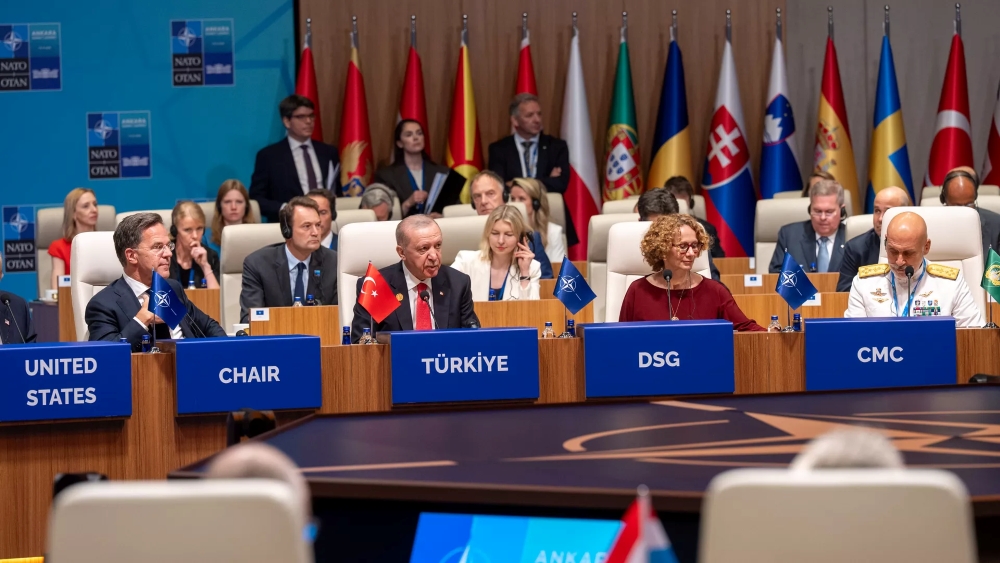
At the Ankara summit, NATO tried to renew its unity and marking a turning point. Apparently, the Alliance would be evolving beyond a military pact as well as emerging as the architect of a defence ecosystem essential for future security. Amid profound geopolitical instability, the Alliance seems to have regained a common direction on 7 and 8 July, responding to Washington’s demands while, at least for now, reducing concerns over a gradual US disengagement.
Nonetheless, the Summit Declaration, the new Strategy for Industry-NATO Cooperation (SYNC), and the contracts announced throughout the summit tell a broader story. They are not simply about higher defence spending or greater European responsibility. Rather, they signal the beginning of a transformation of NATO itself - from a political-military alliance into a platform capable of organising demand, industry, finance and production across the transatlantic defence ecosystem.
What stands out in the final declaration is not so much what it says, but what it leaves unsaid. The document is a one-pager reaffirming NATO's fundamental values, including its "ironclad commitment to […] collective defence under Article 5". Meanwhile, everything else has effectively moved elsewhere - to technical strategies, industrial announcements, and financial initiatives. It is almost as if the political foundations of the Alliance are now taken for granted, while industrial capacity has become the real measure of its credibility.
The Alliance Secretary General Mark Rutte made no secret of his satisfaction. He described NATO as "stronger than ever," spoke of a "huge sense of unity" he had not seen "for a long time," and argued that the Alliance is finally "delivering." Compared with the commitments made only a year ago in The Hague on the path towards spending 5% of GDP on defence, Ankara represents the moment when those promises begin to materialise, given more than $50 billion (€46.2 billion) in newly announced contracts, unprecedented private-sector engagement, and a new industrial architecture designed to sustain defence production.
NATO as an architect of the defence market
More than a political communiqué, Ankara marks the beginning of a new industrial phase for the Alliance. The clearest expression of this shift is the SYNC, which replaces the 2013 framework and reflects a genuine change of paradigm. NATO no longer presents itself solely as a political forum or a military coordination body. Instead, it explicitly defines its role as a "requirements setter, aggregator and delivery enabler."
This may sound like technical language, but its implications are deeply political. NATO is no longer simply coordinating governments - it is beginning to shape the defence market itself by influencing industrial priorities, investment decisions and production capacity.
Every initiative announced in Ankara points in the same direction. The NATO Front Door for Industry creates a single access point for companies, start-ups and SMEs wishing to engage with the Alliance. NATO Engine connects unused manufacturing capacity with companies holding technologies but lacking production facilities, effectively functioning as a "factory-for-hire" model. Even more significant is the introduction of an unclassified demand signal - a public and regularly updated forecast of NATO's future capability requirements, designed to provide industry and investors with long-term visibility and encourage new investment.
Alongside these initiatives comes an equally significant financial shift. Rutte's Call to Action has already secured the support of more than 200 European and North American financial institutions, mobilising roughly $217 billion (€190 billion) in defence-related capital by shifting traditional ESG criteria to classify security as a baseline for sustainability. Defence is increasingly becoming not simply a military issue, but a sector where industrial policy, private finance and technological innovation converge.
It is therefore hardly surprising that Europe's defence industry (through the voice of the Aerospace, Security and Defence Industries Association of Europe, ASD ) welcomed the summit results, as coordinated procurement, aggregated demand and long-term contracts provide precisely the predictability needed to expand production capacity, strengthen supply chains and compete globally.
Not yet strategic autonomy
Yet, the broader picture is more nuanced when it comes to European strategic autonomy.
Despite the stated "avoid duplication" strategy, NATO's latest industrial initiatives do not fully align with EU efforts such as SAFE or EDIP, some of which were explicitly highlighted by Commission President Ursula von der Leyen during the NATO summit.
Similarly, on the industrial side, major procurement announcements like the Saab GLOBALEYE show Europe is expanding its defence role. Eleven NATO allies - including Belgium, Canada, Denmark, Germany, Latvia, Lithuania, Luxembourg, the Netherlands, Norway, Romania, and Sweden - will acquire 10 aircraft to replace aging US-built AWACS. This is complemented by multinational Airbus A400M and A330 MRTT programs, pooling transport and refueling assets to provide essential airlift capabilities.
However, Europe's purchase of 5 Northrop Grumman MQ-4C TRITON drones and more PAC-3 MSE missile interceptors demonstrates that dependencies persist. Militarily, these contracts fill urgent operational gaps that Europe cannot bridge alone. Yet, this also means that critical capabilities - and related intellectual property - remain in the hands of Washington, even if PAC-3 assembly is localized in Germany through a Rheinmetall-Lockheed Martin cooperation.
Even European-built platforms face external constraints, including strict US export controls like ITAR, due to integrated transatlantic components.
As a result, dependencies remain. Yet embedding these capabilities in Europe delivers immediate readiness and helps local factories absorb know-how, laying the foundation for future autonomous defence systems.
NATO of principles VS NATO of contracts
The political messaging, however, remains far removed from the realities of this new industrial NATO.
While Rutte continues to celebrate an Alliance that is "stronger than ever," US President Donald Trump alternates strategic reassurances with inflammatory remarks on issues ranging from Greenland to Iran, reminding Europeans that the transatlantic relationship can no longer be taken entirely for granted.
In many respects, Ankara revealed two different faces of NATO. One continues to speak the language of deterrence and Article 5. The other increasingly speaks the language of industrial capacity, procurement, production timelines, financial leverage, supply chains and technological interoperability.
The meeting probably achieved its immediate political objective: preserving NATO's cohesion at a particularly delicate moment for the Alliance. Yet more than simply reaffirming collective defence, it might also be remembered for redefining how that defence will increasingly be organised and sustained.
Rather than functioning solely as a military alliance founded on common principles, NATO is evolving into an ecosystem in which security, industry, finance and technology operate as parts of the same strategic architecture. It is a new equilibrium. More pragmatic than ideological. More contractual than political. And precisely because of that, it may also prove more fragile.



Privacy Policy

Powered by © Mobilbyte s.a.s. Information Technology