



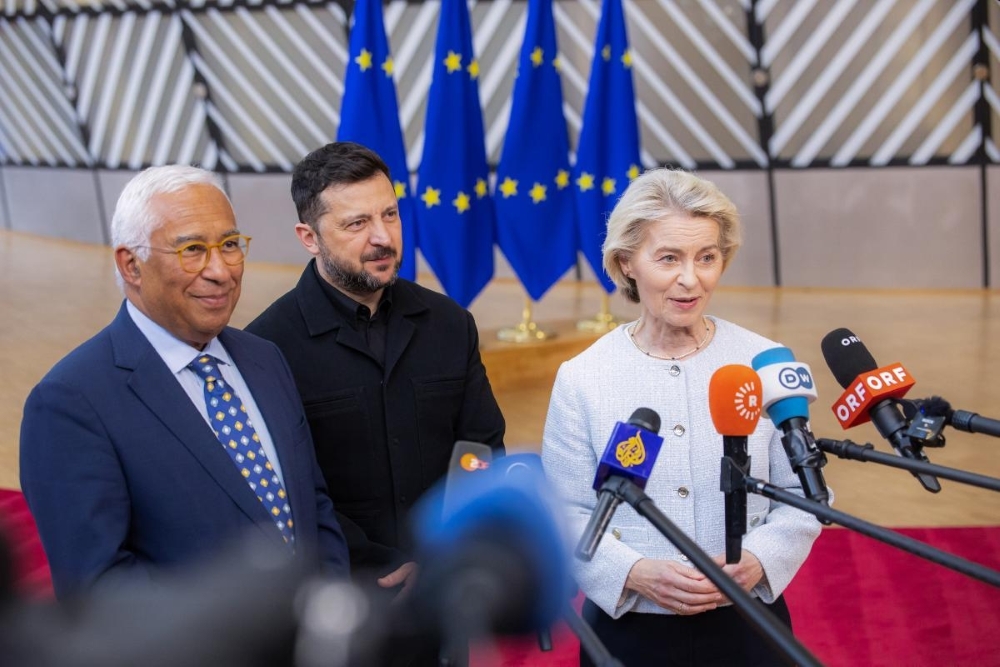
Ukraine has taken centre stage at this week’s European Council meeting. While EU leaders reaffirmed their long-term support for Kyiv and signalled a willingness to accelerate parts of the accession process, a diplomatic initiative launched by European Council President António Costa exposed divisions among member states over how Europe should position itself for a future negotiating phase of the war.
In the official conclusions of the meeting, heads of state and government reiterated their “firm and unwavering support” for Ukraine and formally welcomed the opening of the Fundamentals Cluster during this week’s accession conference with Kyiv.
Covering areas such as rule of law, democratic institutions, judicial reform and anti-corruption measures, the cluster is widely considered the backbone of the enlargement process. Under EU rules, it is the first cluster to open and the last to close. Its activation represents the most significant step in Ukraine’s accession process since candidate status was granted.
“The opening of accession negotiations for Ukraine this week is a historic step and a clear signal of the European Union’s commitment to enlargement,” Costa said, later adding that “the 27 member states are united in supporting Ukraine. Ukraine is moving forward on EU accession. We are stepping up our pressure on Russia. There is momentum, let’s build on it.”
Commission President Ursula von der Leyen struck a similarly optimistic tone. “The opening of the first cluster is a major milestone. Now our goal is to open more clusters before the summer,” she said, while also welcoming the renewal of sanctions against Russia.
The move follows the recent lifting of Hungary’s veto, which had blocked technical progress for months and finally allowed negotiations to move forward. The political signal was matched by commitments to provide “full political, financial, economic, humanitarian, military and diplomatic support” to Ukraine and its people.
The EU also renewed its sanctions regime against Russia for a full year and is already preparing a 21st package of restrictive measures.
Conveying directly on RussiaMeanwhile, behind this display of unity and political support, a much more contentious debate dominated discussions in Brussels.
Responding in part to repeated calls from President Volodymyr Zelensky for Europe to play a more active diplomatic role and avoid being sidelined if negotiations between Moscow and Kyiv eventually begin, Costa’s office quietly established a direct communication channel with Moscow. The initiative involved contacts between Costa’s chief of staff, Pedro Lourtie, and senior Russian officials, with the aim of assessing whether conditions exist for future peace negotiations and ensuring European interests are represented if talks eventually emerge. But the initiative immediately exposed divisions among member states. Belgium, Austria and Slovenia reportedly welcomed the initiative, while Poland, the Baltic states and several Nordic countries questioned both its timing and utility. Other capitals argued that any outreach should instead be conducted through the E3 format involving France, Germany and the United Kingdom.
Questioned by journalists, Costa strongly defended the initiative. “Unfortunately, we don't have credible signals from Russia that Russia wants to engage in serious negotiations for the time being,” he said. “What I'm doing through my office is to establish a direct communication channel, because we cannot depend only on others to interpret Russian messages and we must be able to convey directly to Russia our own messages.”
The European Council president rejected suggestions that the contacts represented a mediation effort or any softening of the EU position. “Only Ukraine can negotiate on behalf of Ukraine,” Costa said. “But in what concerns the European Union's interests, they will need to be defended. The European Union needs to be seated at the table of a future negotiation.”
This clash spotlights a deeper dilemma for European capitals: while backing for Ukraine isn’t in doubt, there’s no easy agreement on how Europe should gear up for the next diplomatic showdown.
Challenging accelerationThat divide is becoming increasingly visible in the enlargement debate itself. Ukrainian officials continue to push for an accelerated accession process, with Zelensky repeatedly referring to 2028 as a target date for EU membership and hoping to anchor that objective in a future peace settlement.
Several member states, however, insist that enlargement cannot bypass established procedures regardless of the geopolitical circumstances. Diplomats point out that countries such as Albania have spent more than a decade in the accession process, while proposals for intermediate forms of integration, including forms of associate membership without voting rights, remain unacceptable to Kyiv.
Leaders are trying to present Ukraine’s accession momentum as a success story. But as Brussels seeks simultaneously to support Kyiv, increase pressure on Moscow and prepare for a future negotiation process, maintaining unity among the 27 may prove just as challenging as dealing with the Kremlin itself.




Privacy Policy

Powered by © Mobilbyte s.a.s. Information Technology