



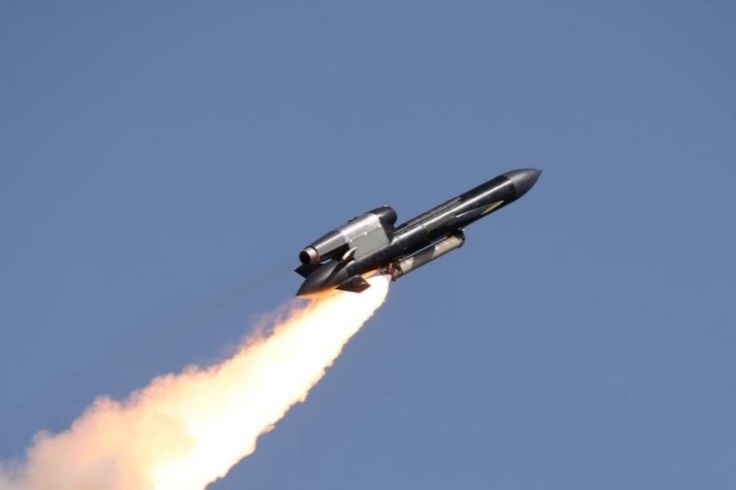
Germany's Diehl Defence, a manufacturer specialized in guided missiles - including the IRIS-T family - air defense systems, and naval and land munitions, is reportedly considering launching production of the Ukrainian FP-5 FLAMINGO cruise missile in Germany.
The announcement came from Diehl Defence CEO Helmut Rauch during a press briefing on the sidelines of the ILA Berlin air show. Rauch stated that in the coming weeks the company will hold a series of meetings with representatives of Fire Point, the Ukrainian manufacturer of the long-range FP-5 FLAMINGO missile.
This would not be the first contact between the 2 companies. In April, Diehl Defence and Fire Point signed a technology cooperation agreement under which the German firm would support the Ukrainian one in integrating a semi-active seeker developed by Diehl on the new FP-7.X interceptor missile. It is plausible that the April agreement also served as an initial exchange on the FLAMINGO, and in particular on its guidance system - about which little or nothing is publicly known.
The FP-5 FLAMINGO is a long-range subsonic cruise missile, in service with the Ukrainian Armed Forces since August 2025. Based on available information and evidence, the system can reach a range of up to 3,000 km and carry a conventional warhead weighing between 1,000 and 1,150 kg, allowing it to strike strategic targets in depth. The missile is powered by a turbofan engine and is launched from a towed ground-based ramp of relatively bulky dimensions, with rocket-booster assistance during the initial flight phase. Aerodynamically, it features a conventional configuration, with a central fixed wing and rear control surfaces. Navigation relies on satellite positioning and the missile is fitted with rudimentary anti-jamming solutions.
Several uncertainties remain about the system's actual operational performance. The comparison between launches claimed by Ukraine and impacts effectively confirmed suggests that the FLAMINGO has not yet achieved particularly significant levels of effectiveness. Available evidence indicates that a significant share of the missiles launched is intercepted by Russian air defenses, while those that reach the target do not always demonstrate sufficient accuracy to deliver the expected operational effects. The system therefore appears as a relatively simple solution geared toward rapid, low-cost production, prioritizing quantity and affordability over technological sophistication. Its size, high radar signature, complex launch procedures, and dependence on satellite navigation make it particularly vulnerable to interception and electronic countermeasures. The system's strengths lie in its long range and the considerable power of its warhead, which make it suited to a long-range strike strategy based on saturation rather than surgical precision.
It is in this context that potential cooperation with Diehl Defence could play a role: integration with German industrial and technological capabilities could not only increase production volumes of the vector but also improve its performance, in particular through possible upgrades to the guidance system, both in the cruise and terminal phases, possibly with the adoption of a dedicated seeker.




Privacy Policy

Powered by © Mobilbyte s.a.s. Information Technology