



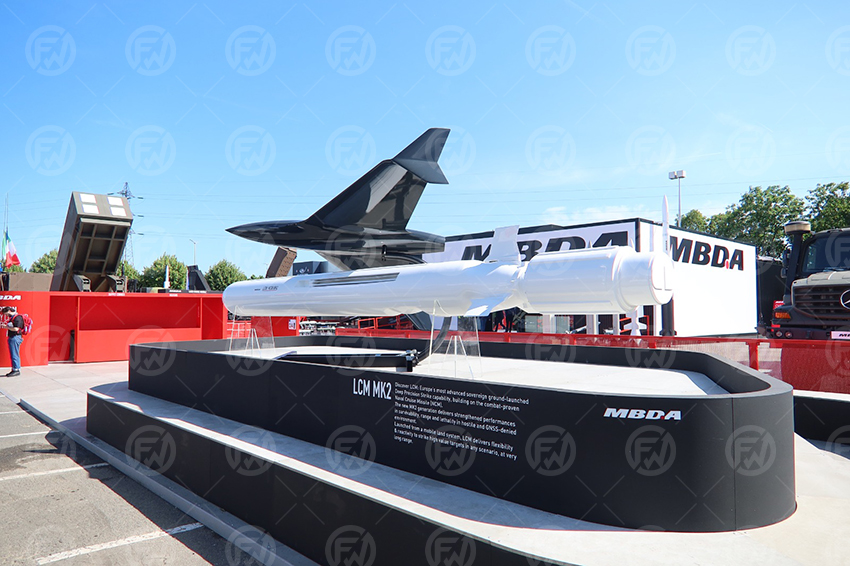
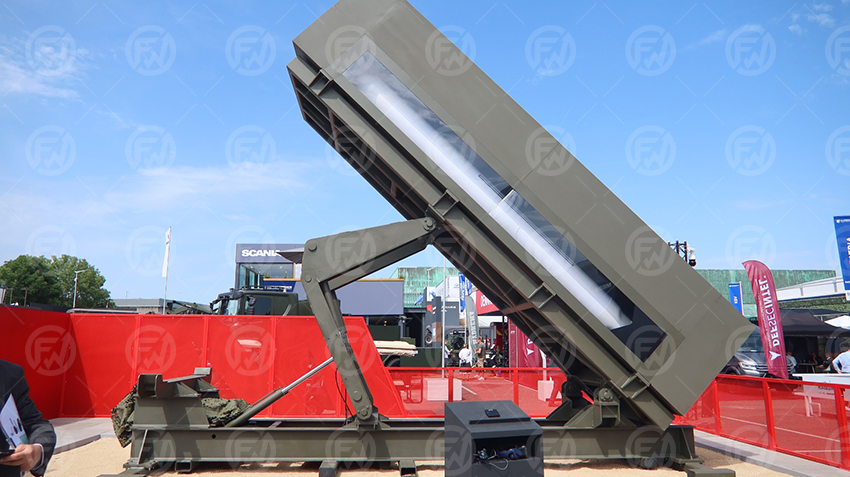
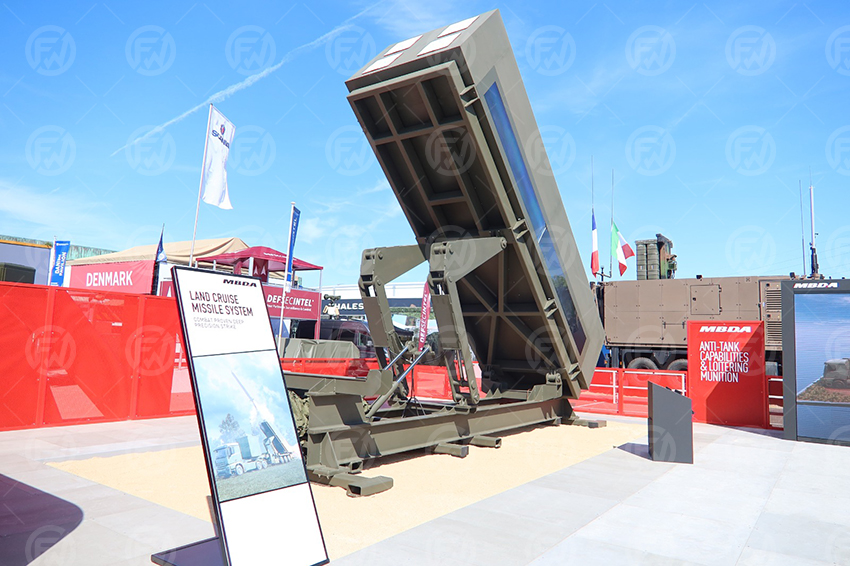
At Eurosatory 2026, MBDA displayed the Land Cruise Missile System Mk-2 (LCM Mk-2) in its outdoor static exhibition area. The system had made its debut at the previous Eurosatory 2024 edition. The LCM Mk-2 is an evolved derivative of the MdCN (Missile de Croisière Naval) / SCALP NAVAL, adapted for land-based employment. During the presentation, MBDA also showcased the Ground Launch System (GLS), a 4-cell launcher developed specifically for the land-based variant.
Compared to the in-service MdCN, the LCM Mk-2 introduces 4 key improvements: a range exceeding 1,000 km (an increase over the current missile), a new Imaging Infrared (IIR) seeker for autonomous target detection, a next-generation anti-jamming system for operations in GNSS-denied environments, and an optimized flight profile and nose geometry for reduced radar cross-section.
The GLS shares its launch architecture with the naval variant. MBDA projects operational availability from 2029.
On the contractual side, MBDA is set to sign an agreement with the French Directorate General of Armaments (Direction Générale de l'Armement — DGA) before the end of 2026 for the acquisition of the LCM Mk-2 in its naval configuration, intended to replace or supplement the SCALP NAVAL missiles currently in service with the French Navy. The land-based configuration remains without a contract for now, having been developed by MBDA France with internal funding. The company has expressed openness to European cooperation on the program.
The development fits within the broader framework of the European Long-Range Strike Approach (ELSA) initiative, launched in July 2024 by Italy, France, Poland, and Germany — subsequently joined by the United Kingdom and Sweden in October 2024 — which aims to develop a ground-launched cruise missile with a range of up to 2,000 km.




Privacy Policy

Powered by © Mobilbyte s.a.s. Information Technology