



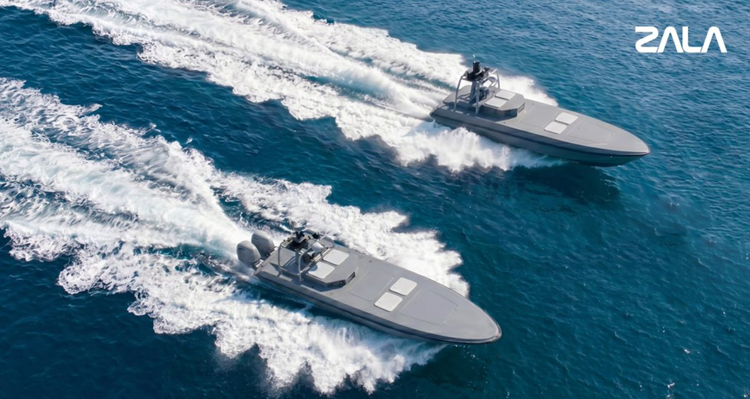
At the International Maritime Defence Show (IMDS) Fleet 2026, held from June 10 to 14 at the Museum of Naval Glory and the Congress and Exhibition Center in Kronstadt (Saint Petersburg), Russian company ZALA, specialized in the development of unmanned systems, unveiled for the first time its multipurpose KAMA unmanned surface vessel (USV), marking its entry into the maritime unmanned systems sector.
Designed as a multirole platform, KAMA is intended for both civil applications and maritime security and surveillance missions. Although the information released by the company focuses mainly on non-offensive uses, the system could potentially also be employed for reconnaissance and target acquisition missions. No attack variant has been announced, although it cannot be ruled out that the platform may in the future be adapted to roles similar to those of modern kamikaze or combat USVs. According to ZALA, KAMA can be used for hydrographic surveys, environmental monitoring, detection of illegal discharges and pollution events, as well as for patrol and surveillance of maritime areas, search and rescue operations, and logistic transport tasks.
The USV offers an operational endurance of up to 12 hours, a top speed of 12 knots (22.2 km/h), a payload capacity of 600 kg and a stated operating range of up to 700 km from the coast. The platform is also capable of automatically holding position in conditions up to sea state 3. Onboard equipment includes an electro-optical system with thermal cameras for operations in low-visibility conditions and an automatic return-to-base function in case of complete loss of communications with the operator.
The introduction of KAMA marks a further step in ZALA's expansion across all domains of unmanned systems. After presenting a multipurpose unmanned ground platform, the Russian company is now strengthening its presence in the maritime sector as well, through a new generation of autonomous surface systems.



Privacy Policy

Powered by © Mobilbyte s.a.s. Information Technology