



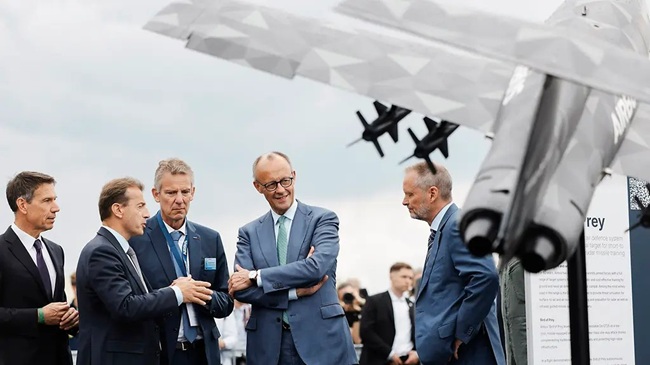
ILA Berlin 2026, the German aerospace exhibition organized by BDLI (the German Aerospace Industries Association, Bundesverband der Deutschen Luft- und Raumfahrtindustrie) and Messe Berlin, opened yesterday, June 10, at the Berlin ExpoCenter Airport and runs through June 14.
German Chancellor Friedrich Merz opened personally the exhibtion, and officially announced the termination of the manned-fighter component — the NGF (New Generation Fighter) — of the Franco-German-Spanish FCAS (Future Combat Air System) / SCAF (Système de Combat Aérien du Futur) program. The decision appears to have been well received by industry: BDLI President and Airbus Defence and Space CEO Michael Schöllhorn described Merz's announcement as the "end of the impasse on the 6th-generation aircraft," signaling that momentum may now build.
On Franco-German cooperation, Merz clarified that the residual core of FCAS — what the Chancellor defined as a "systems of systems" framework — will continue as a joint project with Paris. The defense ministers of the 2 countries are to develop implementation modalities ahead of the Franco-German Council of Ministers, scheduled to be held in Germany in July, where a broader work plan for defense industrial cooperation will also be defined. On the strategic front, Merz reaffirmed the nuclear cooperation initiative launched with France in March, expressing intent to advance President Macron's "extended deterrence" proposal, to which additional European states are expected to adhere.
The German industrial response on the manned-fighter question is already taking shape. According to reporting by the Financial Times, confirmed indirectly by Defense Minister Boris Pistorius, 8 German companies — Airbus DS, MBDA, Hensoldt, Diehl Defence, MTU Aero Engines, Rohde & Schwarz, Liebherr, and Autoflug — have submitted a position paper to the Chancellery and the Ministry of Defense on the development of a German-European 6th-generation fighter under the banner Team Gen 6.
On the same day as the show's opening, the Merz government approved the new German Aviation Strategy (Luftfahrtstrategie), a unified document covering the aerospace industry, civil aviation, and military aviation over a 15-year horizon. On the defense side, key elements include a declared objective of technological sovereignty and the approval by end-2026 of a national legal and regulatory framework for unmanned flight operations (U-Space-Gesetz). Presenting the strategy, Defense Minister Pistorius linked it explicitly to the need for a domestic industry that "avoids excessive dependencies." Merz also cited Germany's 2 drone-sector unicorns — companies valued above $1 billion, an implicit reference to Helsing and Quantum Systems, recently joined by Stark Defence — as key platforms to leverage in implementing the new Luftfahrtstrategie.
German industry moved in parallel on the same technological sovereignty theme on opening day. Airbus unveiled the new CCA U-760 RAVENSTORM, reorganizing its entire drone portfolio under a new "U" nomenclature and around the MARS Autonomy Stack as a sovereign mission system. The company also signed 2 new partnerships: one with Diehl Defence on Integrated Air and Missile Defense (IAMD), and another with Rohde & Schwarz, ConstellR, Orbint, and HPS (High Performance Space Structure System) for a sovereign ISR (Intelligence, Surveillance and Reconnaissance) and Earth observation architecture from space — which we will cover in greater detail tomorrow. On the space side, Rheinmetall presented its own ISR network, built around a joint venture with Finnish company ICEYE; further German industrial initiatives along the same lines will be covered in the full show reportage.
BDLI figures convey the scale of the sector's current growth: German aerospace closed 2025 with €62 billion in revenues — up 19% on 2024 — of which €13.5 billion came from the defense segment (up 35%), with 130,000 employees. The show itself reflects similar momentum: 750 exhibitors from 37 countries, up from 600 from 31 countries in 2024, with approximately 100,000 visitors expected. Two new features make their debut this edition: the Drone Pavilion, complete with a Drone Cage for live demonstrations, and the Military Support Center — a dedicated area in Hall D where the German Armed Forces (Bundeswehr) and industry jointly showcase technologies and systems currently in service or under acquisition, with a particular focus on drones.
(Photo: Berlin Messe)



Privacy Policy

Powered by © Mobilbyte s.a.s. Information Technology