



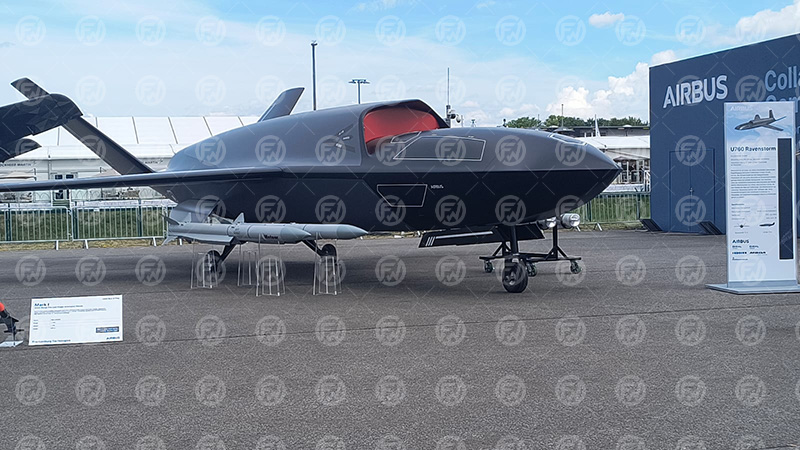
Against the backdrop of the reported cancellation of the manned fighter component of the SCAF/FCAS (Système de Combat Aérien du Futur / Future Combat Air System) programme - announced by the German press in recent days, though still without official confirmation - Airbus Defence and Space has showed off its cards.
At the opening of ILA 2026 in Berlin, the company's stand features a full-scale mock-up of the U-760 RAVENSTORM, a new Collaborative Combat Aircraft (CCA) designed to operate alongside crewed fighters in multi-domain scenarios.
The platform spans 13 m in length and 10 m in wingspan, with a stated Maximum Take-Off Weight (MTOW) of approximately 6 t - a figure that, judging from available imagery and the declared figures, may in practice be higher. Internal payload capacity exceeds 500 kg, augmented by additional external payloads. Cruise speed is high-subsonic. The aerodynamic configuration features a mid-mounted swept wing, twin tails, and a dorsal intake. Airbus targets 2032 for initial operational capability.
In terms of size and overall architecture, the RAVENSTORM sits in a range comparable to that of General Atomics' YFQ-42A - also displayed as a mock-up at the show, and currently flying under the U.S. Air Force CCA Increment 1 program - with which it shares the dorsal intake and twin-tail configuration.
The more direct lineage, however, runs to Airbus's own BARRACUDA demonstrator of 2006, explicitly cited by the company as the foundation of the current design. The RAVENSTORM appears to be an upscaled evolution: the BARRACUDA measured 8.25 m in length and 7.22 m in wingspan, with an MTOW of 3,250 kg, making the RAVENSTORM noticeably more elongated proportionally.
The RAVENSTORM unveiling is the centerpiece of a broader rebranding exercise. In a press release issued on the eve of the show, Airbus presented what it describes as "Europe's most versatile drone portfolio," reorganizing its uncrewed platforms under a new "U" nomenclature — running parallel to "A" for crewed fixed-wing and "H" for crewed rotary-wing. The new family comprises the RAVENSTORM; the U-740 VALKYRIE (the Europeanized derivative of the Kratos XQ-58A); the U-145 (an uncrewed variant of the H-145 helicopter, also on display); and the U-950 EURODRONE (EUROMALE), plus various tactical solutions also shown at the event. Both the RAVENSTORM and the VALKYRIE integrate Airbus's sovereign mission system MARS (Multiplatform Autonomous Reconfigurable and Secure), which incorporates the Mindshare AI software and is declared scalable across the full uncrewed portfolio.
Declared capabilities for the RAVENSTORM cover air-to-surface with Precision-Guided Munitions (PGM), air-to-air with medium- and long-range Air-to-Air Missiles (AAM), and electronic warfare. The mock-up is displayed with 2 MBDA METEOR air-to-air missiles and 4 MBDA SPEAR air-to-surface missiles, indicating the 2 primary payload configurations.
The modular architecture will, according to Airbus, allow for incremental capability insertion. As far as the future EUROFIGHTER TYPHOON EK (Elektronischer Kampf) is concerned (the German electronic warfare variant), the RAVENSTORM is a plausible candidate as a companion drone, though other platforms in the new portfolio, including the VALKYRIE, remain theoretically eligible.
The relationship between RAVENSTORM and VALKYRIE also requires further definition. The RAVENSTORM is positioned as a higher-end, higher-cost sovereign European platform; the VALKYRIE, designed from the outset as low-cost and runway-independent, appears oriented toward a more attritable role.
The industrial argument is, however, the one Airbus presses hardest. The RAVENSTORM is explicitly presented as a "sovereign European solution," in deliberate contrast to the VALKYRIE which, as a derivative of the U.S.-origin XQ-58A, remains subject to International Traffic in Arms Regulations (ITAR) and the associated Washington restrictions on export, modification, and operational employment. On the VALKYRIE, Airbus also states a 2029 entry into service with the German Air Force (Luftwaffe), though no formal German selection has yet been made. The status of the WIMGMAN - the stealth loyal wingman concept shown at ILA 2024 - remains unaddressed; it does not appear in the new "U" portfolio.
On the European CCA market, and specifically against the Luftwaffe's requirement to be met by 2029, the Airbus portfolio competes with at least 3 other systems: the CA-1 EUROPA from German startup Helsing (developed with Grob, integrating Hensoldt's MDOcore sensor and software suite); the Boeing MQ-28 GHOST BAT, offered to the German customer through the partnership formed in March 2026 between Boeing Defence Australia and Rheinmetall; and the General Atomics YFQ-42A, which the California-based company is actively pushing into European markets, including through its own industrial presence at Oberpfaffenhofen, near Munich.




Privacy Policy

Powered by © Mobilbyte s.a.s. Information Technology