



As it is often the case, Israeli small and mid-sized defence companies are arriving at Eurosatory 2026 as a coherent technology vanguard, translating hard battlefield lessons into converging trends in autonomy, survivability, sensing and connectivity. Wars in Ukraine, Gaza and across the Middle East have compressed innovation cycles, turning SMEs into rapid-prototyping laboratories for what is now becoming the reference architecture of high-intensity warfare.
A major shift since the 2024 edition is the move from isolated systems to integrated autonomous "combat ecosystems" that sense, decide and act with minimal human intervention. For instance, Ondas' MODUS mobile counter-UAS platform and IRON WAVE robotic combat suite epitomise this approach, combining sensing, decision-making and robotic manoeuvre into a unified operational framework. MODUS fuses CoRF cyber detection, GNSS disruption, radar, AI-driven EO sensing, autonomous interceptors and layered effectors into a single sensor-to-shooter system designed to follow manoeuvre forces and protect them against low-altitude threats, including fibre-optic-guided drones and swarms that have proven resistant to traditional jamming.
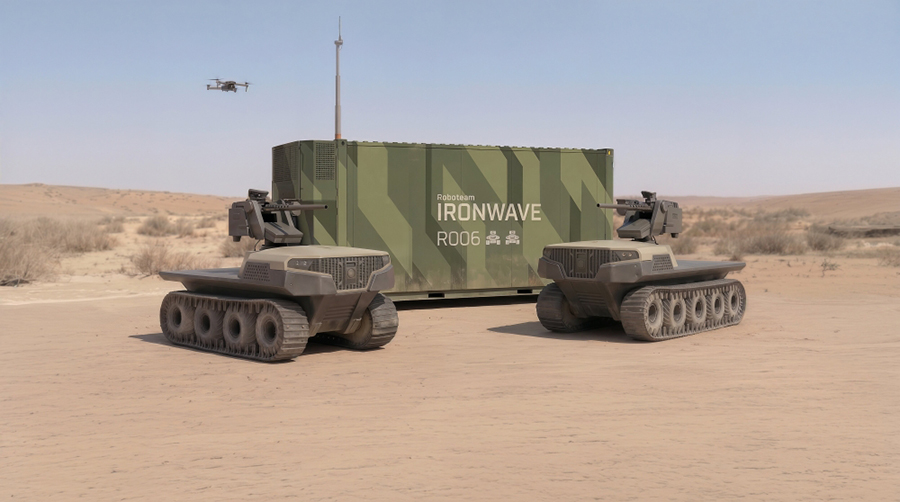
IRON WAVE pushes autonomy further forward by operationalising the "bots before boots" concept, placing robotic combat vehicles and surveillance platforms ahead of ground forces for route clearance, EOD, reconnaissance, logistics and forward support. Small teams can control multiple robotic assets via AI-assisted coordination from a deployable command unit and multi-platform operator stations, shrinking the gap between emerging threats and fielded robotic counter-measures. Esh-Tech's DRONELIGHT fits into the same trend from the effector side: a pulsed-laser hard-kill C-UAS system that neutralises drones in 1-2 seconds with around 4 kW of power, making laser effectors realistic for mobile units, not just fixed high-value sites. Together, these systems turn counter-drone defence and robotic manoeuvre into mutually reinforcing elements of an autonomous protection layer around manoeuvre formations.
Survivability becomes active, ergonomic and directional
On the survivability axis, Israeli firms are moving from purely passive armour concepts to active, ergonomic and directional protection solutions tuned to specific threat vectors. Plasan's new suite - LAPS, ATHENA and TAPS - is emblematic. LAPS, a leg active protection system integrated into energy-attenuating seats, detects a mine blast within milliseconds and lifts the occupants' legs before floor impact, dramatically reducing injury risk without adding hull weight or consuming internal volume. This is battle-proven mine protection re-imagined as a human-centric, electro-mechanical response rather than yet another steel or composite layer.
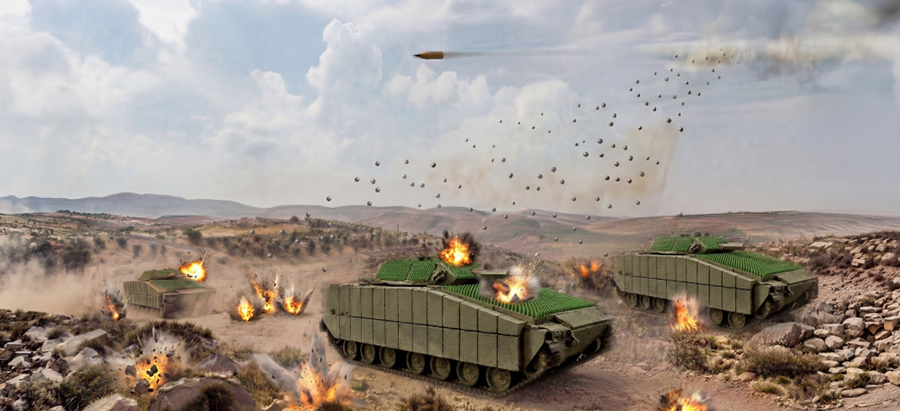
ATHENA, a non-explosive reactive armour, addresses shaped charges, RPGs, EFPs and kinetic penetrators by combining composite armour with an expanding interlayer that reacts on impact to disrupt the threat - eliminating the collateral risks associated with explosive or semi-explosive tiles while improving versatility and cost-effectiveness. TAPS, Plasan's top-attack protection system, answers the now-routine threat of artillery submunitions and top-attack profiles by adding an above-roof shielding layer that has already been tested and approved by multiple Western armies. IMCO's work on HUMS, AI-enabled situational awareness video systems and new display infrastructures complements these hardware measures by improving platform resilience, diagnostics and crew perception, effectively turning the vehicle into a monitored, self-aware system rather than a passive protected box.
Accelerated sensing for high-dynamic engagements
Across air and land domains, Israeli SMEs are compressing the sensing chain, delivering sharper, faster imagery and better situational awareness for platforms that manoeuvre aggressively. For example, SCD's ROBIN family of 12 um LWIR uncooled detectors is designed specifically for high-dynamic applications such as missile seekers, loitering munitions, autonomous effectors and agile UAS payloads. By achieving a thermal time constant of
This performance directly tackles the limitations of current-generation uncooled sensors, which often require heavy gimbals or extensive post-processing to cope with platform motion, adding weight and integration complexity. ROBIN's modularity - from bare detectors to video modules and fully integrated cores - allows the same technology to be reused in armoured vehicle situational awareness, degraded-visibility driving, missile warning systems, weapon sights and persistent surveillance. IMCO's AI-enabled SAVS system builds on this by fusing multiple visual feeds around vehicles into a coherent, user-friendly picture, with next-generation interfaces that support rapid integration of new sensors without hardware redesigns. In parallel, DRONELIGHT's narrow field of view, absence of side lobes and automatic tracking show how precision sensing and effect are converging into tightly coupled kill chains optimised for cluttered urban environments.
Multi-orbit connectivity for unmanned and distributed forces
The fourth major trend is the normalisation of resilient, multi-orbit SATCOM as a baseline requirement for unmanned systems and distributed operations. Gilat Defense's RAYSAT VIPER Ka-band electronically steered antenna (ESA) is engineered for UAVs that demand secure, very low-latency links with strict size, weight and power constraints, while minimising aerodynamic penalties. The antenna supports LEO, MEO and GEO constellations and can dynamically select the optimal orbit based on mission needs, ensuring continuity in contested or congested spectrum environments.
VIPER is not a standalone antenna but part of a broader Gilat ecosystem of modems, mobile and transportable terminals, BUCs and SATCOM-on-the-move capabilities, enabling end-to-end connectivity for tactical air, land and maritime missions. In combination with robotic systems like IRON WAVE and sensor-rich platforms equipped with ROBIN detectors or IMCO's vetronics, this type of multi-orbit connectivity underpins a battlespace where autonomous assets, shooters and commanders remain tied into a resilient digital network even under intensive electronic warfare.
Wars as accelerators, SMEs as system architects
Across these trends, the distinction between "improved existing" and "genuinely new" is best understood at the architectural level. Systems like ROBIN, SAVS, or VIPER are evolutionary in their technology base but are being re-architected for high-tempo, autonomy-heavy operations, backed by design-to-scale manufacturing and AI-ready roadmaps. By contrast, solutions such as DRONELIGHT's low-power tactical pulsed laser C-UAS, Plasan's active leg protection and non-explosive reactive armour, or Ondas' integrated MODUS/IRON WAVE ecosystems represent new operational categories that did not exist even a few years ago in this form.
Eurosatory 2026 therefore highlights how sustained exposure to combat has turned these companies into system architects of future land warfare, where autonomy, tailored survivability, accelerated sensing and resilient connectivity have become core design principles.
Follow us on Telegram, Facebook and X.





Privacy Policy

Powered by © Mobilbyte s.a.s. Information Technology