



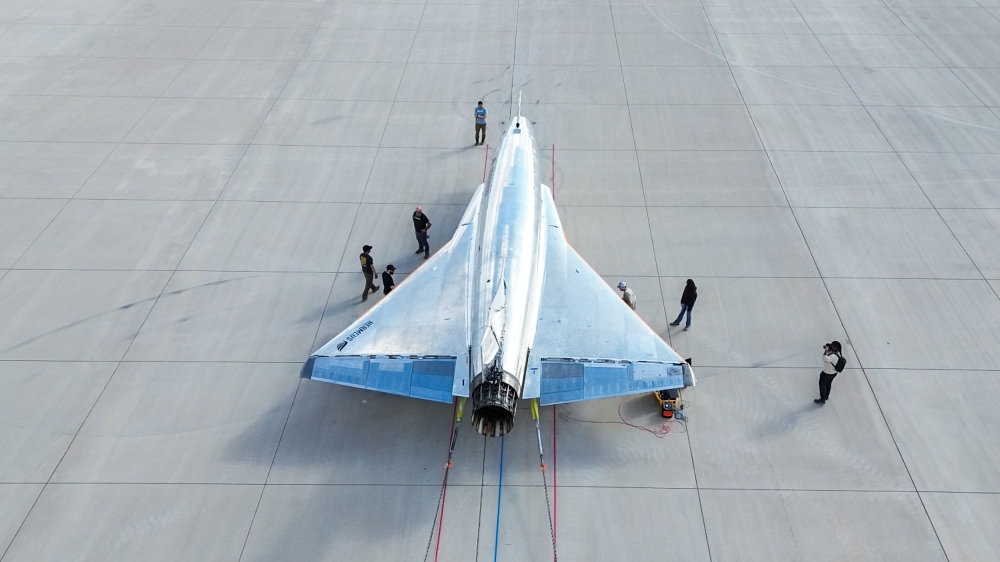
The US Department of War’s Defense Innovation Unit (DIU) awarded the startup HERMEUS a new $159 million contract, under which the company will provide flight data gathered in upcoming flights of its QUARTERHOSE supersonic uncrewed air vehicle. This data will feed into DIU, USAF and US Navy plans and concepts for future high-speed military aircraft. This is a modification to an earlier contract and brings the cumulative value of the agreement to $219 million.
Hermeus, founded in 2018, aims to develop high speed aircraft for both military and commercial customers through a rapid, iterative prototyping approach. The attainment of hypersonic speeds is its ultimate goal, but on the way there it will first deal in high supersonic speeds, up to Mach 3, through its QUARTERHORSE uncrewed aircraft. Hermeus has more than 275 employees across four different locations in Atlanta, Los Angeles, Washington D.C., and Jacksonville, FL.
So far, a non-flying testbed and 2 flying QUARTERHORSEs have been produced: the Mk1 debuted in 2025, powered by a J85 engine, to demonstrate high speed take off and landings at Edwards Air Force Base in California. The second aircraft, Mk 2.1 is about the size of an F-16, features a variable inlet, a delta wing design, and is powered by a Pratt & Whitney F100 engine. Mk 2.1 made its maiden flight at Spaceport America in February 2026, less than a year after Quarterhorse Mk 1’s first flight. On its third flight, Mk 2.1 reached a top speed of Mach 1.21, as announced on May 26. In doing so it became the first privately funded uncrewed aircraft to ever hit supersonic speeds.
The Company is already building aircraft Mk 2.2 and 2.3 which will progressively push the speed towards Mach 3: QUARTERHORSE 2.2 is expected to hit Mach 1.6 in flight testing already during this summer, with 2.3 achieving Mach 3 during 2027, according to HERMEUS’s president, Zachary Shore.
The DoW has already provided some seed funding for HERMEUS’s ambitions in the past. Back in 2020, the USAF’s innovation arm, AFWERX, awarded 1.5 million USD for studies towards a future hypersonic Presidential Airlift Fleet. In 2021, the investment increased through a $60 million follow-on contract.
It was in 2023 that DIU awarded 23 million in funding to QUARTERHORSE within the wider framework of its Hypersonic and High-Cadence Airborne Testing Capabilities program (HyCAT). Although QUARTERHORSE is not and won’t be hypersonic (HERMEUS plans a follow-on series of aircraft for that, known as DARKHORSE), the contract supported the demonstration of propulsion systems, thermal management approaches, power generation, and mission system capabilities useful to a range of Pentagon projects.
While the DoW remains interested in the future hypersonic re-usable aircraft, the supersonic QUARTERHORSE could find applications as well. Current Collaborative Combat Aircraft are notably all high-subsonic, so the high speed sets QUARTERHORSE apart. HERMEUS claims the aircraft could offer a payload capacity of up to 20,000 pounds with 20 kilowatts of available power. Combined with its eventual intended Mach 3 speed, this could result in various combat, strike, electronic warfare and ISR applications.
The key development that will enable the future DARKHORSE hypersonic reusable aircraft is the CHIMERA hybrid engine combining turbine and ramjet in order to take off conventionally, breaking the sound barrier, and then accelerate to hypersonic speeds (Mach 5 and beyond).




Privacy Policy

Powered by © Mobilbyte s.a.s. Information Technology