



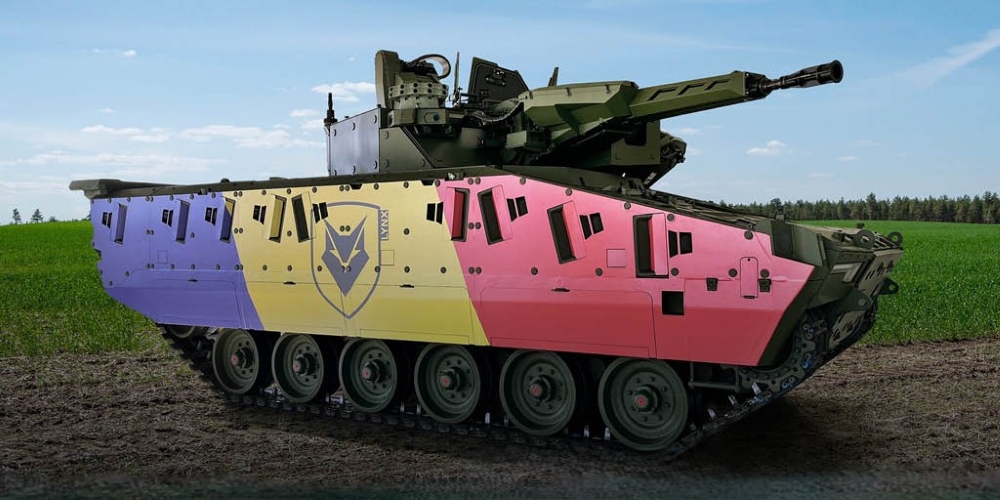
On 2 June 2026, Rheinmetall announced the largest international contract package in its recent corporate history: a €5.7 billion deal awarded by Romania's Directorate General for Armaments covering combat vehicles, air defence systems, ammunition, and naval vessels.
As reported by FW-MAG, the contracts were signed under the European Union's Security Action for Europe (SAFE) funding mechanism and formally awarded on 29 May. They represent a decisive chapter in Romania's decade-long effort to replace its Soviet-era military hardware and emerge as a relevant pillar of NATO's eastern flank.
The package encompasses four distinct capability streams. At its core are 298 LYNX KF41 infantry fighting vehicles (the majority in armoured personnel carrier configuration, with reconnaissance, command post and medical variants rounding out the fleet) set to replace the ageing MLI-84 JDERUL, a licence-produced derivative of the Soviet BMP-1 that has been in service since the 1980s and has long been considered a critical vulnerability in Romania's ground order of battle.
Alongside the IFVs come SKYRANGER air defence systems built on the same LYNX chassis, medium-calibre ammunition for both air defence and armoured vehicles, two offshore patrol vessels and two diver support vessels based on Rheinmetall's new Naval Systems segment design. As an interim measure, Rheinmetall will also keep Romania's existing GEPARD twin-35mm self-propelled anti-aircraft guns operational until the SKYRANGER systems are introduced.
For the Düsseldorf group, the strategic weight of this contract goes well beyond its headline figure. The package is explicitly described by the company as the largest international contract in its recent history, validating CEO Armin Papperger's stated ambition to cement Rheinmetall as "one of the industrial pillars of European security".
Romania has long been one of Rheinmetall's home markets: its subsidiary Rheinmetall Automecanica (RAM), based in Medias, Transylvania, has operated in the country for years and will now serve as the production hub for the LYNX programme. The deal also extends Rheinmetall's footprint into a new domain (naval systems) and shows for the first time the group's capability to exploit NVL to operate beyond its traditional land and air defence strongholds. With deliveries scheduled to begin in 2028 and conclude by 2030, the contract provides multi-year revenue visibility at a moment when European defence budgets are accelerating across the board.
Romania's strategic imperative
The strategic logic driving Bucharest is impossible to separate from Romania's geography. Sharing a 650-kilometre border with Ukraine, Romania has experienced repeated Russian drone incursions into its airspace and the threat of floating mines in Black Sea shipping lanes — a security environment that has elevated the country from a peripheral NATO member to the host of the Alliance's largest airbase in Europe at Mihail Kogalniceanu. Romania is the second-largest beneficiary of the EU's SAFE instrument after Poland, receiving loans up to €16.68 billion for armed forces modernisation, with a first instalment of €8.33 billion authorised by Parliament in April 2026.
The Rheinmetall contract, funded under this mechanism, accounts for more than a third of that initial tranche alone. For the Romanian Army - with some 52,000 land forces personnel organised around mechanised brigades still partially equipped with T-55 and TR-85 main battle tanks, MLI-84 IFVs and legacy artillery — the LYNX acquisition resolves the most urgent gap in its ground manoeuvre capability. The procurement of 298 vehicles, including 252 IFVs and 46 specialised derivative variants, will transform the mechanised brigades into genuinely NATO-interoperable formations, with Minister of Defence Radu-Dinel Miruta publicly endorsing the programme despite earlier tensions over reported price escalations of up to 30% compared to initial bids. The naval component (four vessels in total) directly addresses Romania's Black Sea security requirements at a moment when the country is simultaneously acquiring NSM coastal defence systems and a HISAR-class corvette from Turkey.
The industrial dimension of the contract may ultimately prove as consequential as the military one. Rheinmetall has committed to investing several hundred million euros in Romania, with over 50% of production value to be generated domestically or in collaboration with local companies, and more than 200 subcontractors to be integrated into the supply network, an arrangement expected to create thousands of new jobs.
Mihai Jurca, Head of the Prime Minister's Office and coordinator of the SAFE implementation working group, described the deal as "an important step towards revitalising the national defence industry" and "the beginning of a new phase of industrial development" capable of driving economic growth and integrating Romanian firms into the European defence ecosystem. The RAM plant in Medias is the immediate production anchor, but the ripple effects reach further.
Rheinmetall has separately established a joint venture with state-owned Pirochim Victoria to build a propellant powder factory in Victoria, Brasov County, with investment estimated at €535 million. The facility is expected to produce 300,000 tonnes of propellant powder annually and position Romania as a critical node in European ammunition supply chains. This dual investment transforms what was once a cluster of atrophied, legacy state-owned enterprises into a more integrated defence industrial corridor in Transylvania.
The policy framework enabling this transformation is Emergency Ordinance No. 124/2023, which modernised Romania's offset requirements to mandate technology transfer, local supply chain integration, and research collaboration as conditions for major contracts. The Rheinmetall deal is the first high-profile test of this framework at scale, and its architecture (deep localisation, joint ventures, subcontractor networks) is likely to become the template against which future major procurement decisions in Bucharest are judged. Whether Romanian firms such as Uzina Mecanica Bucuresti and Automecanica Medias can graduate from assembly lines to genuine Tier 1 design-and-manufacture capability remains the open question, but a multi-billion commitment, backed by EU financing and the credibility of Europe's fastest-growing defence group, provides as credible a launch pad as any post-Soviet NATO member has yet secured.



Privacy Policy

Powered by © Mobilbyte s.a.s. Information Technology