



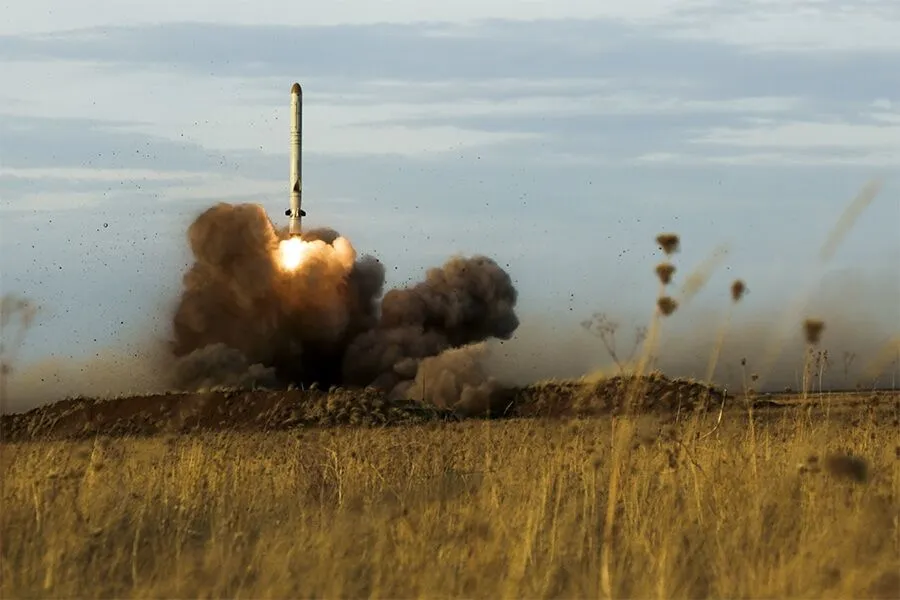
In the wake of the heavy Russian missile strikes that hit the Ukrainian capital in late May, video and photographic evidence has emerged apparently showing the wreckage of a 9M729 NOVATOR cruise missile.
The system, developed by Russian firm NPO Novator, is one of the most advanced iterations of Russia's family of ground-launched cruise missiles derived from the ISKANDER-K platform. While full technical specifications remain classified, the missile is estimated to have a range of 2,000–2,500 km and is believed to carry a conventional warhead of approximately 500 kg, with a nuclear-capable variant also reported. Guidance relies on a combined INS/GLONASS system and, in all likelihood, TERCOM and DSMAC (Digital Scene Matching Area Correlator) capabilities for terminal-phase precision against ground targets.
Launches are conducted from an experimental variant of the ISKANDER-M1 OTRK (Operational-Tactical Missile System), capable of carrying up to 4 missiles at a time. Approximately 24 ISKANDER-M1 OTRK launchers are reportedly deployed in the Ukrainian theater.
For the record, the NOVATOR was at the center of the U.S.-Russia tensions that culminated in the collapse of the INF (Intermediate-Range Nuclear Forces) Treaty in 2019. In terms of operational use, the system is not new to the conflict: it has reportedly been employed on at least 25 previous occasions — 2 of them during the opening phase of the 2022 invasion, with the remaining uses occurring from August 2025 onward.
The deployment fits into what appears to be a broader rationalization of Russia's missile arsenal. Air-launched missiles such as the Kh-101, while effective at long range, are relatively expensive, logistically demanding, and increasingly vulnerable to interception. Against this backdrop, Russia has been progressively diversifying its strike systems, making greater use of KALIBR, KINZHAL, ISKANDER-M, and ISKANDER-K — platforms that offer greater operational and logistical flexibility. ISKANDER-K family systems — including the 9M729 NOVATOR — are generally less costly than air-launched cruise missiles, and are likely available in sufficient quantities to support saturation strikes and large-scale employment.




Privacy Policy

Powered by © Mobilbyte s.a.s. Information Technology