



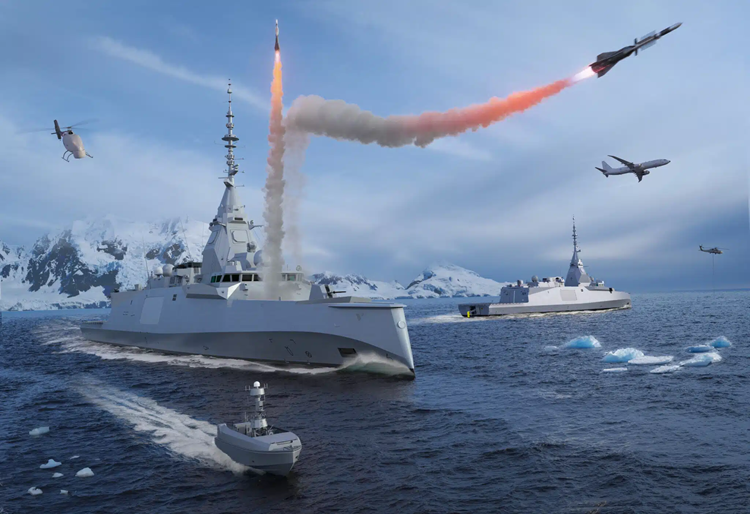
Stockholm announced today, 19 May, the selection of Naval Group's Frégate de Défense et d'Intervention (FDI) as the reference platform for the Swedish Navy's LULEA-class programme. The decision was unveiled by Prime Minister Ulf Kristersson and Defence Minister Pal Jonson at a press conference held aboard the Visby-class corvette Harnosand, moored at Skeppsbron.
The programme covers the acquisition of 4 units, to be built in Lorient on the production line already running for the French Navy and the Hellenic Navy. The first delivery is expected in 2030, at a rate of one unit per year through 2033. Today's announcement is a down-select – i.e. the identification of the preferred supplier – with contract signature expected within the second half of 2026. The overall programme value has not been disclosed, but government estimates released in recent months put it between 40 and 60 billion Swedish kronor (€3.6-5.4 bn), including weapons and long-term in-service support. This marks the Swedish Navy's return to the frigate category after more than 40 years, since the last HALLAND-class units were retired in the early 1980s.
The FDI prevailed over Babcock/Saab's ARROWHEAD 120 and Navantia's A-4000 on three counts: speed of delivery (thanks to a production line already open), design and combat system maturity, and the opportunity to share development costs with France and Greece.
Of the three bids, the FDI was the only one based on a design already in production and in service. It remains to be seen how the FDI will perform in Baltic and North Atlantic waters, given that the class was designed for very different operating environments: the Mediterranean, the Persian Gulf, and France's overseas territories in the Indo-Pacific.
The Swedish units will carry both the ASTER-30 and the CAMM-ER. The VLS configuration has not been officially disclosed, but is most likely to consist of 32 Sylver A50 cells, the standard now adopted by the French Navy from the fourth unit of the class onwards (the Hellenic Navy adopted it from the outset on the KIMON class).
The ships will be fitted with Swedish systems and weapons, too: RBS-15 anti-ship missiles, TORPED 47 torpedoes, TRACKFIRE remote weapon stations and Bofors 57 mm and 40 mm guns. Although not officially confirmed, the combat management system is expected to be Naval Group's SETIS rather than Saab's 9LV proposed by the competitors – a choice that would mean giving up commonality with the other naval units currently in service with the Swedish Navy.
The deal fits into a broader Franco-Swedish bilateral cooperation package, made explicit by French President Emmanuel Macron himself, who linked the FDI selection to France's acquisition of two Saab GLOBALEYE AEW&C aircraft intended to replace the Armée de l'Air et de l'Espace's E-3F SENTRY fleet.
On the industrial side, Naval Group had signed on 2 February 2026 a Memorandum of Understanding with the Swedish shipyard Oresund Drydocks for the development of a national hub for maintenance and through-life support of the FDIs: Swedish industry involvement will therefore be limited to the integration of Saab and BAE Systems Bofors systems and to MRO activity – a smaller footprint than what was offered by the two competing bids, particularly the Babcock/Saab one, which had the Swedish company as prime contractor.



Privacy Policy

Powered by © Mobilbyte s.a.s. Information Technology