



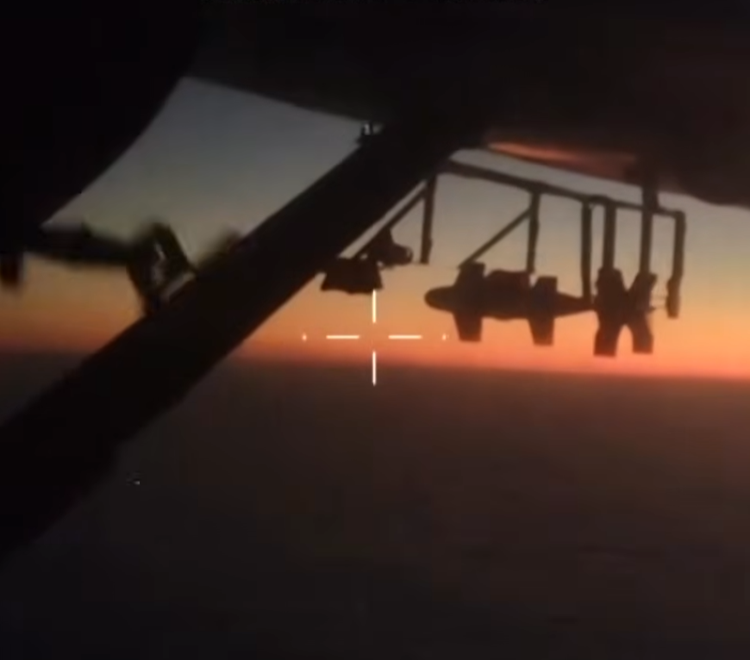
Ukrainian forces have employed for the first time the PZL-Mielec An-28TD light twin-turboprop transport aircraft as a "drone carrier" platform for launching interceptor drones.
The aircraft is equipped with three pylons per wing designed for P1-SUN interceptor drones, developed by SkyFall and operated by crew members on board. These systems feature an operational range of up to 15 km, an operational ceiling of approximately 5,000 m, and an endurance of between 15 and 17 minutes, allowing up to six interceptors to be carried per mission. The integration of additional solutions is reportedly under evaluation, including U.S.-made MEROPS systems.
The aircraft is fitted with an electro-optical system for visual target search and identification, enabling crews to detect incoming drones prior to interceptor launch. According to available information, the An-28TD also retains its onboard armament, consisting of a Dillon Aero M134D Minigun chambered in 7.62×51 mm, which has proven particularly effective against SHAHED/GERAN-type drones. This configuration allows for combined employment of conventional weapon systems and interceptor drones, increasing tactical flexibility and multi-layered engagement capability within a single sortie.
The An-28TD is particularly well suited to this role due to its ability to operate from unprepared or improvised airstrips. The aircraft has a wingspan of 22 m and a length of 12.98 m, can carry up to 19 personnel including drone operators, and reaches a maximum speed of 355 km/h with a range of up to 1,900 km. These characteristics allow it to remain airborne for extended periods during counter-drone missions. During operations, the An-28TD is directed toward targets by ground controllers within the national air defense command and control network known as VIRAZH. Once in the operational area, the crew proceeds to visually identify targets — often under night conditions — prior to engagement.
The VIRAZH system represents an evolution of Ukraine's air defense network, built around a multilayered and highly integrated approach. Unlike traditional models centered exclusively on radar, it combines data from approximately 40 sensor types, including radar, infrared sensors, video feeds, and an extensive network of acoustic sensors. The latter rely on low-cost devices — such as smartphones and commercial components — distributed widely across the territory to detect the sound signatures of drones and missiles. Artificial intelligence enables the system to distinguish between civilian noise sources and actual threats, transmitting data to an analysis hub via mobile network.
Complementing this is the more advanced ZVOOK system, based on dedicated acoustic sensors and machine learning algorithms, capable of operating effectively at low altitudes where radar performance degrades. The integration of these sources allows VIRAZH to build a real-time air threat picture, improving response speed and interception accuracy. The system is notable for its high adaptability and relatively low costs, though it does present certain limitations related to the range of its acoustic sensors and their sensitivity to environmental conditions.
The employment of the An-28TD in an anti-drone role had already been reported as early as February. In the preceding months, crews had used a Dillon Aero M134D Minigun mounted on a swivel support in the fuselage's side door for direct target engagement. This employment stands as an emblematic example of Ukraine's approach — the rapid adaptation of civilian platforms and legacy systems to counter the threat posed by drone swarms, significantly reducing costs compared to the use of far more sophisticated and expensive interceptor missiles.
The innovative deployment of the An-28TD demonstrates how Ukrainian forces have developed an advanced counter-drone warfare capability, combining light civilian assets, modern sensors, and innovative solutions to counter an adversary with considerably superior production capacity.




Privacy Policy

Powered by © Mobilbyte s.a.s. Information Technology