



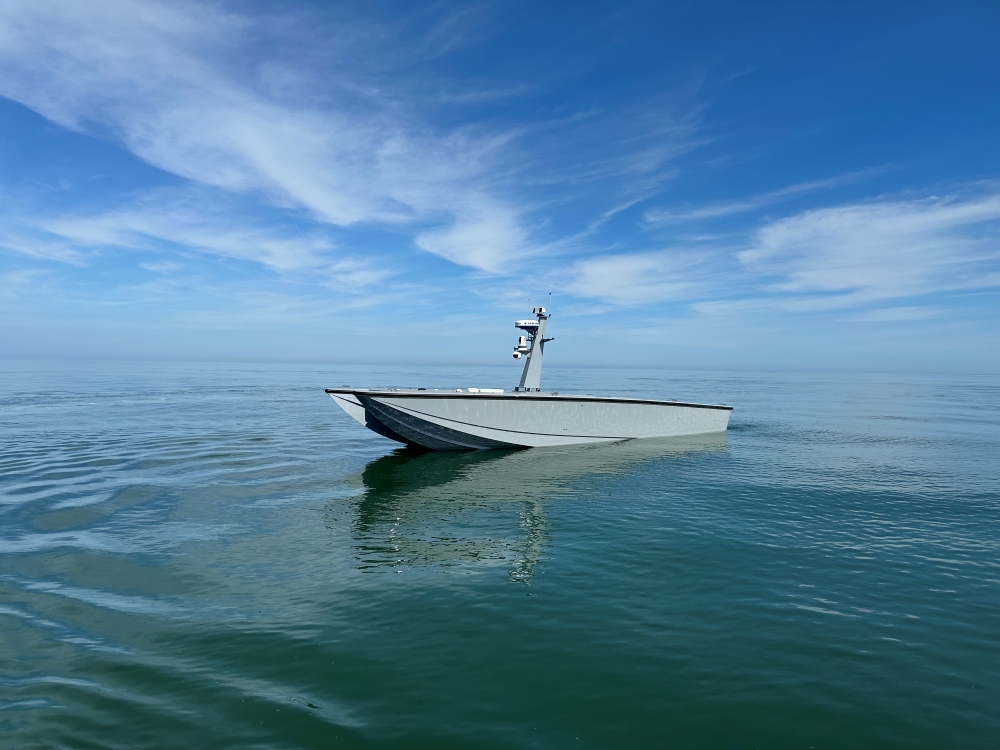
At the Sea Air Space expo at the National Harbor, outside of Washington, DC, FW MAG spoke with Seamus Flatley, Chief Growth Officer at the Florida-based MARTAC Systems. The company discussed with FW Mag its upcoming deliveries and projects to expand its family of uncrewed surface vessels (USVs) for new missions.
The company delivered one DEVIL RAY T-38 and four T-12 USVs to the Philippine Navy in July of 2024. Two additional T-38s will be delivered in May of this year, MARTAC confirmed exclusively to FW MAG. Flatley added that his company has “ongoing discussions about future opportunities with the Armed Forces of the Philippines.” The T-38s are equipped with the launch-and-recovery system manufactured by the Israeli company Sealartec.
With a length of 11.1 meters (38 feet) and the capacity to carry up to 1,814 kilograms (4 thousand pounds) of payload, the Devil Ray T-38 is the company’s flagship. “This USV is the equivalent of a Ford F-150 pick-up truck,” Flatley summarized about the T-38’s capabilities.
MARTAC also confirmed to FW MAG that it has an undisclosed US government customer: the T-38 currently in production for this customer has a range of 4,100 nautical miles at 5 kts and a 1,100-gallon fuel capacity. At a speed of 50 kts, the range of the USV reaches 1,200 miles.
The company is expanding its fleet of USV systems. At SAS, the company displayed the DEVIL RAY T-38; however, a larger system is in development: the LEVIATHAN T-82, a 24.9-meter (82 feet) USV made of carbon fiber and designed for high modularity. Flatley confirmed to FW MAG that a prototype will be ready for trials by the winter/spring of 2027. Flatley also explained that the future Leviathan T-82 will have a sack configuration to deploy MARTAC’s smaller USVs, as well as mines and other small deployable effects.
Integrating more payloads is the name of the game for uncrewed systems, and Flatley explained to FW MAG that the DEVIL RAY T-38 is designed for modularity, as it can transport a variety of payloads, such as sonars, anti-submarine warfare technology, and tethered/untethered uncrewed aerial systems. The company also confirmed that it tested Aerovironment’s SWITCHBLADE loitering munition, which was launched from the T-38. “The SWITCHBLADE successfully hit a static maritime target,” MARTAC added.
The company has also developed the monohull MUSKIE M-18, a one-way attritable USV with a 226 kg (500 pounds) capacity. MARTAC declined to discuss upcoming demonstrations.
In recent years, several global navies have commenced acquiring and/or experimenting with USVs (and uncrewed underwater vehicles, UUVs) to determine how they can be integrated into their existing fleets and support crewed ships and submarines. The US Navy, for example, wants to develop a hybrid fleet. At the same time, other navies like the United Kingdom, Australia, Turkiye, and Brazil have carried out their own recent tests (FW MAG recently discussed maritime swarms and USV/UUV technology in an analysis titled “Controlling the Swarm: are we there yet?” published in the most recent issue). However, applying the lessons learned and concepts developed within relatively limited theaters of operation, such as the Black Sea and the Strait of Hormuz, is challenging to scale to a global level and to more open theaters of operation, such as the Indo-Pacific.
Companies like MARTAC aim to demonstrate that their uncrewed systems can assist navies with very specific tasks and areas of operations (e.g., the Philippines) and global navies like the US, which operate across different environments.



Privacy Policy

Powered by © Mobilbyte s.a.s. Information Technology