



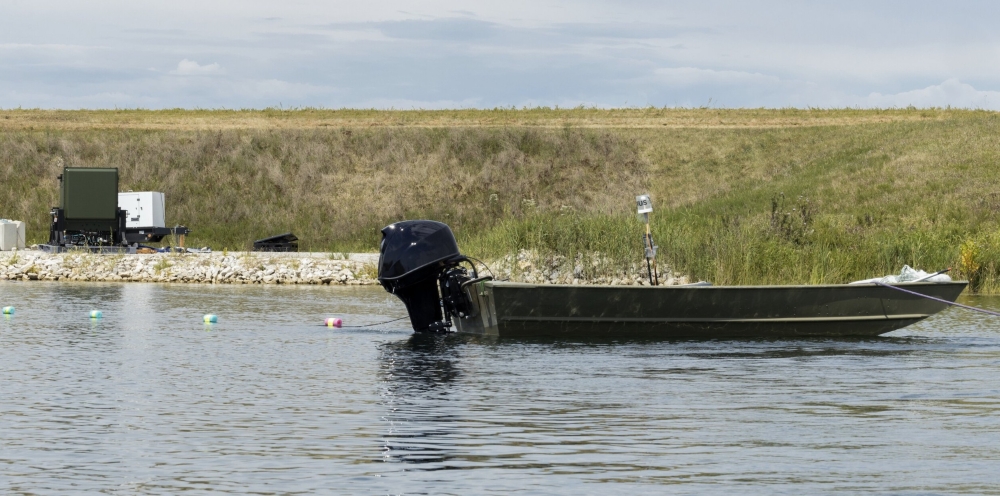
Epirus, the producer of LEONIDAS, a high-power microwave (HPM) counter-uncrewed system (C-UxS) platform, is advancing across multiple fronts in 2026. Besides integrating its LEONIDAS HPM system with GDLS & Kodiak AI and seeking to break into the Latin America market, the company is also working on a maritime version: enter LEONIDAS H2O.
At the Sea Air Space expo in Washington, DC, FW MAG spoke with company spokesperson Andrew Wargofchik about LEONIDAS H2O. The company has already demonstrated the system at a “recent” US Navy-sponsored testing via the Advanced Naval Technology Exercise Coastal Trident (ANTX-CT) program, in which LEONIDAS successfully neutralized four out of four target uncrewed surface vessels (USVs) by “disabling multiple commercial-grade vessel motors” which had 40 to 90 horsepower at a multitude of ranges, the company explained in a press release. To clarify, the LEONIDAS H20 was located on the shore and fired at maritime targets. The live fire demonstration was coordinated by the Naval Surface Warfare Center, Port Hueneme’s Office of Technology.
The next goal is to test the LEONIDAS H2O aboard a US warship and, in the future, explore integration with a USV. “Our system is very modular and scalable,” Wargofchik explained. The goal is to containerize LEONIDAS H2O for multi-class vessel integration. LEONIDAS H2O is currently in the prototype stage, and Epirus is seeking a contract with the US military to “further mature the solution.”
Follow us on Telegram, Facebook and X.
The company added in a press release that LEONIDAS H2O can protect ships and infrastructure against threats like “autonomy-enabled ‘dark’ drones, mass swarms, and surface-based autonomous vessels.” Aerial drones include Group 1 and Group 2, but the HPM platform can be scaled to address larger threats. Wargofchik explained to FW Mag that LEONIDAS H2O can be part of a “layered defense” to protect warships against incoming autonomous threats.
While Epirus wants LEONIDAS to go maritime, the company is simultaneously developing other solutions and delivering land-based platforms to the US Army and US Marines. The company confirmed to FW Mag the delivery in recent years of two IFPC-HPM Generation II systems for the US Army (valued at USD$43.5 million), the delivery of four IFPC-HPM Generation I systems to the US Army under a USD$66.1M contract, and the delivery of one Expeditionary Directed Energy Counter-Swarm (ExDECS) system, a compact, expeditionary HPM system for counter-swarm in austere, forward-deployed environments, to the US Marine Corps.
At the recent AUSA Global Force expo in Alabama, the company teamed up with General Dynamics Land Systems (GDLS) and Kodiak AI to develop the LEONIDAS Autonomous Ground Vehicle (AGV). To summarize, the three companies placed the LEONIDAS HPM on the flatbed of a commercial-grade truck equipped with Kodiak AI’s autonomous driving system.
Finally, the company is also looking for international customers. Specifically, Epirus has offered the LEONIDAS HPM to the Colombian government as the South American country aims to develop a counter-UAV shield. Wargofchik declined to discuss the status of the negotiations.
As global militaries aim to procure and deploy a variety of uncrewed systems in combat operations, there is a similar demand for counter-UxS solutions to defeat them. The potential options are vast: there are kinetic solutions, including autonomous weapons systems that can lock onto a UxS; some companies are developing fire control systems for dismounted troops, making it easier for a ground soldier to locate and shoot down a drone. The historical concern about using an expensive, multi-million-dollar weapon to eliminate a 20-thousand-dollar drone is true both in the air and at sea. Epirus believes this another reason why the US and other partners and allies will be interested in LEONIDAS, including LEONIDAS H2O, as it is a cost-effective solution to a complex and expensive problem.




Privacy Policy

Powered by © Mobilbyte s.a.s. Information Technology