



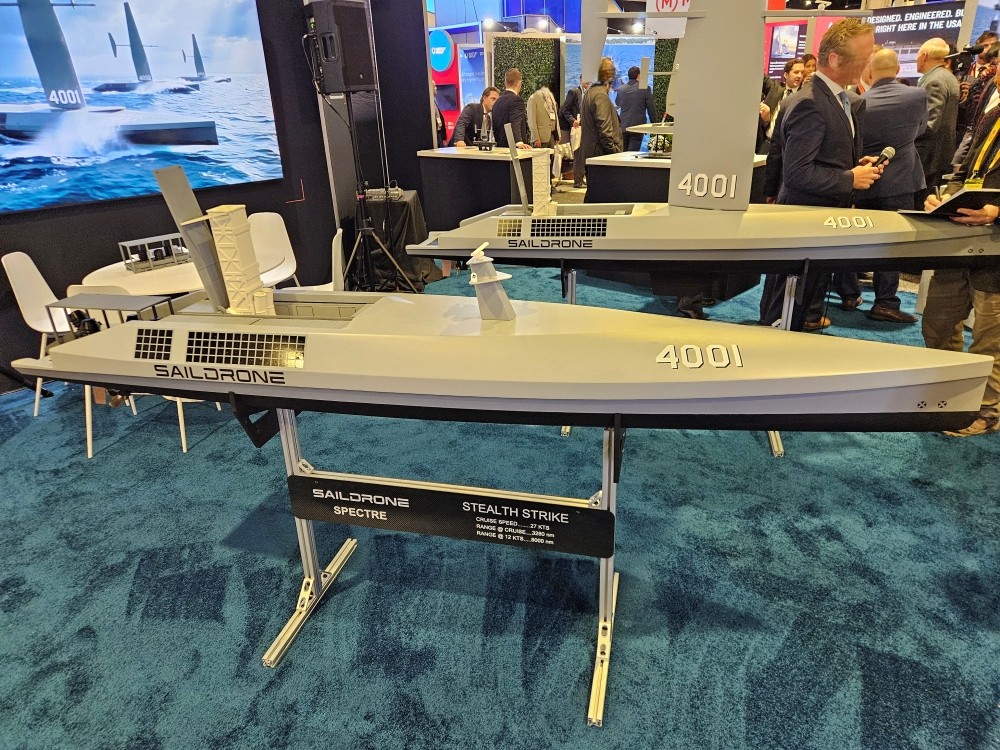
At the Sea Air Space (SAS) expo outside Washington, DC, Saildrone unveiled the design of its brand-new SPECTRE uncrewed surface vessel (USV). FW MAG attended a media briefing with Saildrone at SAS on Monday, 20 April, to learn more about SPECTRE.
Specifically, the company has developed two variants of SPECTRE: SPECTRE SILENT ENDURANCE, which comes with the Saildrone Wing for “extreme endurance and near-silent propulsion.” The system is optimized for anti-submarine warfare and other acoustically sensitive missions. Meanwhile, SPECTRE STEALTH STRIKE is a wingless variant designed for “higher sprint speeds and a lower-profile configuration for kinetic strike roles.”
SPECTRE will be built in Wisconsin at the Fincantieri shipyard system, which can manufacture up to five SPECTRE vessels per year, the company explained in a press release. Construction will begin “shortly,” with the first vessel undergoing sea trials in early 2027.
At the media briefing at SAS, Richard Jenkins, Saildrone’s founder and CEO, stated that each SPECTRE will cost around USD$40 million. The executive confirmed that Saildrone will compete in the US Navy’s Medium Uncrewed Surface Vessel (MUSV) program, and stated that SPECTRE “fits perfectly” with what the service is looking for.
At the unveiling ceremony, executives from Thales, Lockheed Martin, and Fincantieri joined Saildrone’s Jenkins to display the design of the new USV. They also explained what types of missions the new USV can engage in: anti-submarine warfare was often mentioned as a current capability gap that SPECTRE can fill. Moreover, the executive from Lockheed Martin noted that since SPECTRE can transport missile payloads aboard, the USV “puts more players on the field, more shooters.” Meanwhile, the Thales executive added that SPECTRE can transport a sonar; by deploying the USV ahead of a main battle force, the USV can “ping the adversary” and inform the rest of the fleet without putting crewed ships at risk.
The USV is made of aluminum, is 52 meters (170 feet) long, weighs 250 tonnes, and can travel up to 30 knots. The speed is achieved through its multiple propulsion capabilities: twin shaftlines with dual electric and diesel propulsion, enabling near-silent electric propulsion up to 12 knots. In comparison, the cruise speed reaches 25 knots with a 25,000 kg payload. The USV has a range of 3,280 nautical miles in calm waters and 2,790 nautical miles in Sea State 4 on the Beaufort Scale, which is generally considered moderate waves and breeze.
The concealed payload deck provides space for containerized payloads, ranging from dual 12.1-meter (40-foot) containers to up to five 6-meter (20-foot) containers, or a mix of configurations in between. SPECTRE’s maximum payload capacity is over 70 tonnes. The 43-meter (140-foot) composite Saildrone Wing will be manufactured by American Magic Services (AMS) at the American Magic High Performance Center in Pensacola, Florida.
The platform underwent a two-year design phase, the company confirmed, and Lockheed Martin partnered with Saildrone to develop the USV. The partnership with the global defense company means that SPECTRE is compatible with a wide range of Lockheed Martin payloads, including towed arrays such as the thin-line TB29 and the Mk70 vertical launching system (VLS). SPECTRE can also carry two Mk70 missile launchers and is capable of deploying the CAPTAS-4 variable-depth sonar (VDS) system, manufactured by Thales and Advanced Acoustic Concepts (AAC).
Lockheed Martin announced back in October 2025 a USD$50 million investment in Saildrone to deliver USVs “equipped with lethal, combat-proven defense technology.” Moreover, during the SAS briefing, a Lockheed Martin executive mentioned that, at the upcoming RIMPAC exercises, a Saildrone Surveyor USV will be equipped with a Lockheed Martin launch capability to demonstrate the successful integration of both technologies.
The USV market is becoming increasingly congested as more navies seek to deploy USVs and uncrewed underwater vehicles (UUVs) for certain missions in the near future. The US Navy’s objective to create a large, hybrid fleet is a clear example of this goal. The next milestone in the evolution of USVs is adding third-party payloads to increase their capabilities. Radars and sonars to locate an adversary, or a missile system as an offensive capability, would help protect crewed ships in future combat operations.
Follow us on Telegram, Facebook and X.




Privacy Policy

Powered by © Mobilbyte s.a.s. Information Technology