



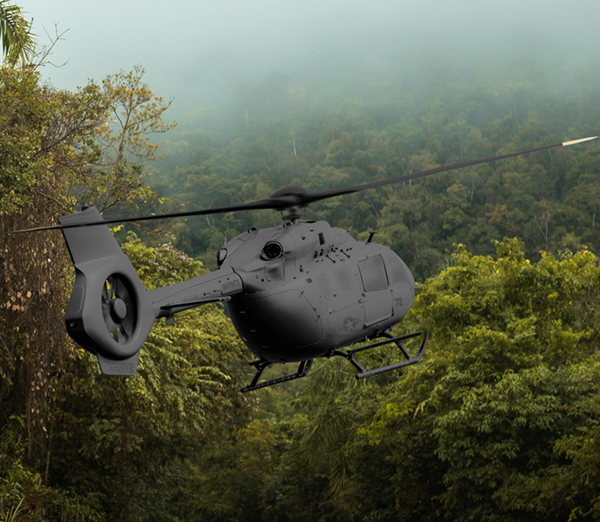
Airbus US Space and Defense announced on 15 April the fourth autonomous flight test of an H145 helicopter. Prior to the Sea Air Space expo, which will take place at the National Harbor, close to Washington, DC, on 20-22 April, FW MAG spoke with Carl Forsling, Senior Director for Strategy and Business Development at Airbus, about this new test and how the company’s autonomous rotary-wing aircraft can assist the US armed forces, particularly the Marines.
The recent test flights took place at the Airbus facility in Grand Prairie, Texas, and “focused on refining the aircraft’s perception system” to ensure the platform will provide “accurate, real-time information to an autonomous pilot ensuring obstacles are avoided within a landing zone,” the company explained in a press release. The helicopter autonomously evaluated a landing zone, detected potential obstacles, and rerouted to an alternate site if needed.
Airbus is teaming up with L3Harris, Shield AI, and Parry Labs to develop this autonomous platform. The company is in the second year of the Aerial Logistics Connector Middle Tier of Acquisition (MTA) Rapid Prototyping Program. In May 2024, Naval Air Systems Command (NAVAIR) awarded Airbus US Space & Defense a Phase I Other Transaction Authority (OTA) through the Naval Aviation Systems Consortium for the future MQ-72C Lakota Connector platform. Forsling explained that the MTA-RP requires Airbus (and partners) to produce an operational capability within 60 months, meaning by the spring of 2029: “we’re confident we can do that,” he explained to FW MAG.
A small clarification is required: the H145 helicopter (which carried out the recent autonomous flight test) is the commercial version of the UH-72 LAKOTA helicopter. The LAKOTA CONNECTOR will be the uncrewed variant of the LAKOTA.
Forsling explained to FW MAG that the company, along with its partners, is carrying out both demonstrations and tests. “In both 2024 and 2025, we did demonstration events with the Marine Corps, where we deployed an H145D3 helicopter to Marine bases to perform operationally representative tasks with various cargoes,” the executive noted. More demonstration events will follow, as the “prototyping effort continues,” and they “will incorporate higher levels of autonomy and be more integrated with real-world scenarios.”
Meanwhile, Airbus and its partners are carrying out an “aggressive flight test program. Since last June, we’ve done four major series of flight tests.” The executive highlighted that “in each round, we’ve added increased capability in terms of systems integration and autonomy.”
The program's basic idea is to develop a heavy-duty helicopter drone capable of carrying a variety of heavy cargo (joint intermodal modular containers and ordnance containers) for missions across different environments, including ship-to-shore (and vice versa), ship-to-ship, and shore-based missions. Forsling added that “we’ve prioritized the logistics mission because that is essential to the success of Marine Corps Expeditionary Advanced Base Operation”. However, the system is very “versatile” and can be utilized for other missions, such as the delivery of other uncrewed aerial systems, launched effects (electronic warfare, sonobuoys, or ISR systems), search and rescue, and casualty evacuation/medical evacuation.
Forsling declined to discuss with FW MAG exactly how much cargo the LAKOTA CONNECTOR can carry, but stated that it “exceeds the requirements” identified by the USMC. Airbus is confident the platform is ideal for expeditionary missions as it is affordable to build and to maintain in quantity, making it risk worthy; moreover, the platform requires “far less maintenance than any other helicopter in the military’s fleet,” and minimal training is necessary for a human operator to operate it, the company told FW MAG.
Logistics and supply chains can determine the victor or loser of a battle. Supplying frontline troops with ammo, food & water, medical supplies, and other equipment is critical to maintain the momentum of a mission. Crewed helicopters or air drops from fixed-wing aircraft are the standard aerial options for supporting expeditionary missions when land (or maritime) routes are unavailable, but aircraft crews are at risk in either case. Hence, the development of an expendable helicopter drone capable of transporting heavy cargo to support frontline troops (or other ships) is a rational idea and can be a game-changer in how logistics operations are carried out.
Anecdotally, on 15 April, the US military announced that a two-week series of shipboard tests of the TRV-150C tactical resupply drone (produced by Survice) was carried out aboard an amphibious transport dock ship, including launch and recovery, with a focus on ship-integration efforts. The goal of having a resupply drone aboard a ship, to support other ships or troops on land, moves forward.
Follow us on Telegram, Facebook and X.




Privacy Policy

Powered by © Mobilbyte s.a.s. Information Technology